
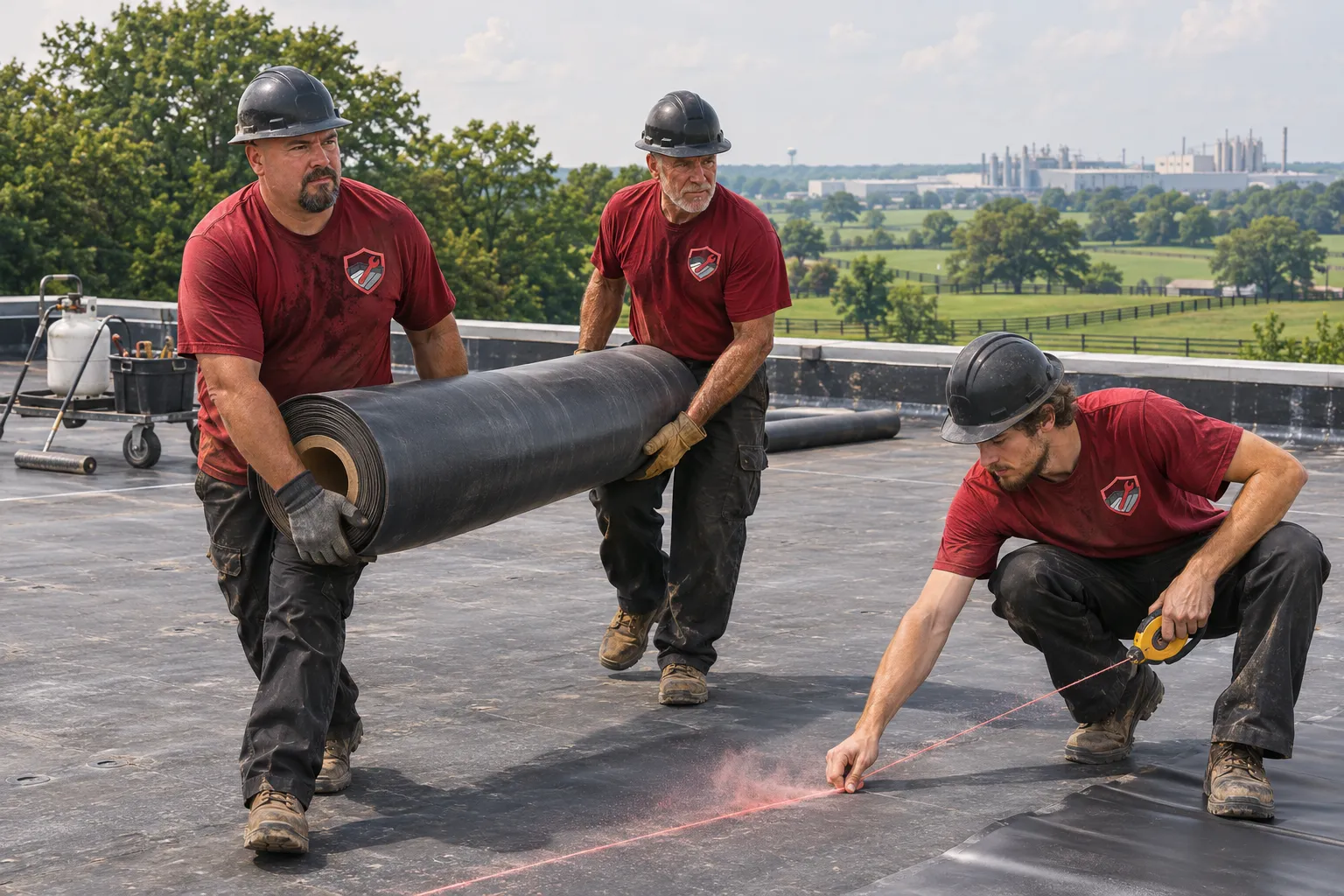
Roof repair crew in logo uniforms patching a commercial flat roof membrane
Repair FAQ · Georgetown, KY

Commercial Roof Repair Questions In Georgetown

Plain Answers on Leaks, Seams, Drains, Permits, and Repair Costs

These commercial roof repair questions in Georgetown cover flat, metal, leak, and plant roof repairs, plus weather, permits, costs, and taxes.

  • 39 questions, nine topics
  • Permit offices by town
  • Georgetown weather and storms
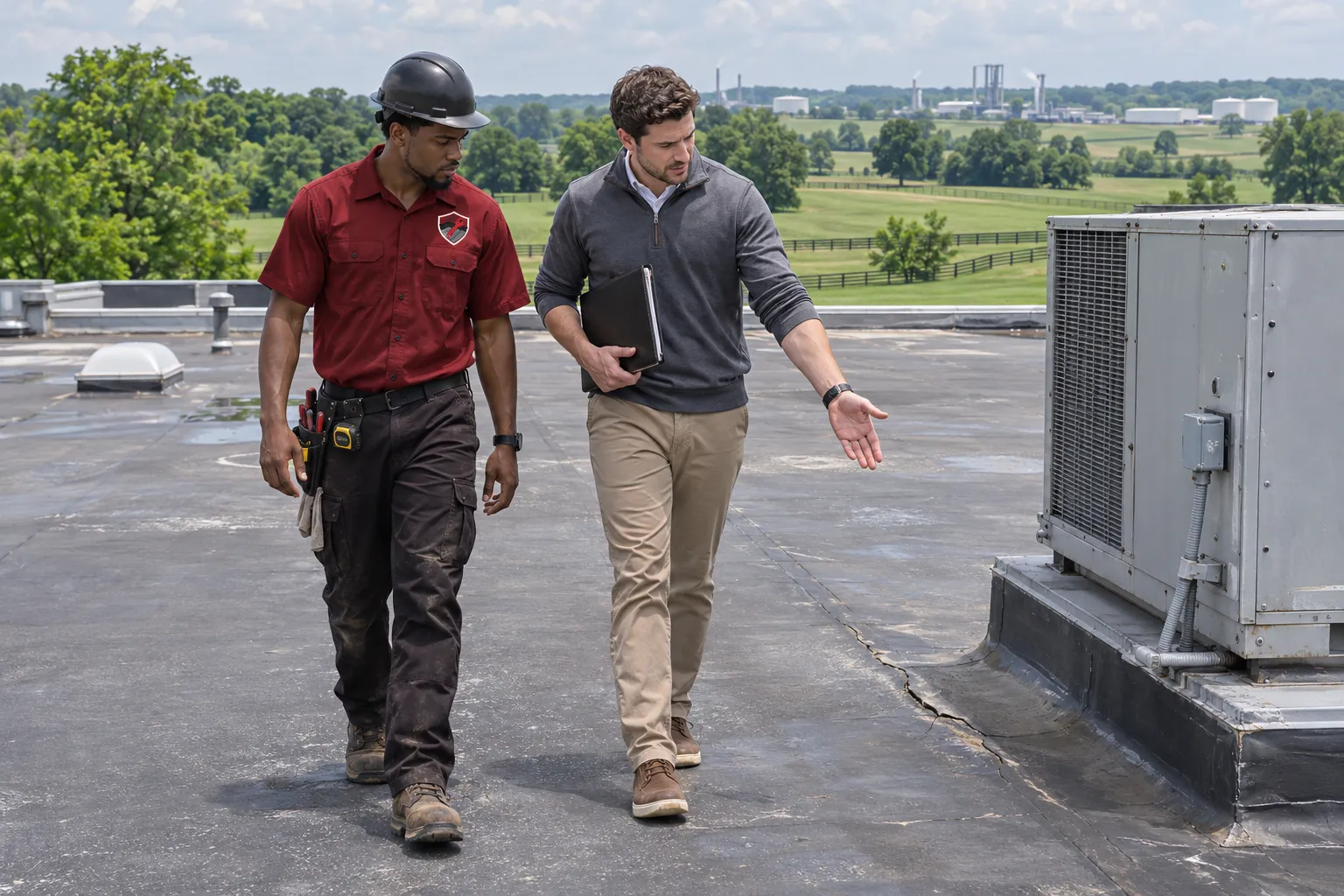
Roofer in a logo uniform walking a commercial flat roof to check seams and drains

Browse Commercial Roof Repair Questions In Georgetown

Pick a topic below. These commercial roof repair questions in Georgetown cover leak tracing, flat and metal repairs, plant roofs, storms, permits, and costs.

Commercial roof repair is fixing leaks, open seams, failed flashing and damaged panels on business, industrial and farm buildings so the existing roof stays in service. Georgetown Commercial Roof Repair traces and repairs leaks on flat and metal commercial roofs in Georgetown and surrounding towns of Scott County, Kentucky.

Basic Commercial Roof Repair Questions From Georgetown Owners

What does a commercial roof repair cover?

A commercial roof repair fixes a defined problem on an existing roof, such as an open seam, a cracked pipe boot, a loose panel or a clogged drain, and leaves the rest of the roof working. Patches follow the original material so they bond and move with the roof.

Roof typeCommon repair items
TPO and PVCWelded patches, new boots, reflashed curbs
EPDMPrimer and tape patches, new seam tape
Modified bitumen and built-upTorch or cold-applied patches, blister cuts
MetalFastener swaps, lap sealing, panel sections

Each patch extends past the damage far enough to bond to clean, dry roofing on every side.

Should I repair, restore or replace my commercial roof?

The share of the roof that is wet or worn out settles whether it gets repair, restoration or replacement. Isolated damage calls for repair, an aging but dry roof suits restoration, and wet or failed roofing across wide areas calls for replacement.

OptionScopeFits when
RepairPatches, seams, flashings, drainsDamage sits in a few spots
RestoreRepairs plus a coating or new surfaceMembrane is aging, insulation is dry
ReplaceTear-off down to the deckWet insulation or failures roof-wide

Core samples or an infrared scan show how much insulation under the membrane is wet, and that number drives the choice.

How does a temporary roof repair differ from a permanent one?

Temporary repairs stop water fast with products that stick to a wet or cold roof, and permanent repairs use matching materials on a clean, dry, prepared surface. A temporary patch holds things until the weather allows the real fix.

FeatureTemporary repairPermanent repair
MaterialsWet-surface mastic, tape, tarpsMatching membrane, welded or primed patches, new metal
SurfaceWet or dirtyCleaned and dry
WeatherDuring or right after a stormInside the material's temperature range
Follow-upReplaced with a permanent fixChecked at the next inspection

Photograph and mark every temporary patch on a roof plan so each one gets replaced on the next dry day.

Can a roof repair be done while the building stays open?

Most commercial roof repairs go on with the building open, because the work stays on the roof and in a small area. Ladders, hoists and material piles are set up away from customer entrances and walkways.

Items to arrange:

  • Interior protection under the leak, such as tarps over stock or machinery
  • Shutdown of a rooftop unit while its curb or intake is worked on
  • Hatch or ladder access and the key holder's number
  • Notice to tenants before torches or hot-air welders run

Primer and adhesive odors can drift into air intakes, so units near the repair are shut off for a short time.

Flat Roof Repair Questions

What problems turn up most on commercial flat roofs?

Open seams, punctures, blisters, ponding and failed flashing at curbs and walls are the problems that turn up again and again on commercial flat roofs. Each leaves visible signs on the surface.

ProblemWhat you see
Open seamLifted lap edge, dirt line along the seam
PunctureSmall hole or cut near units or walkways
BlisterRaised bubble in the membrane or bitumen
PondingDirt rings or algae where water sits
Flashing failureMembrane pulling away from walls and curbs
ShrinkageTight membrane bridging the corner at walls

When several of these show up together on an aging roof, the decision starts to lean toward restoration or replacement.

How are seams and punctures repaired on TPO, EPDM and PVC?

Single-ply seams and punctures are repaired with matching membrane, welded on TPO and PVC or primed and taped on EPDM. The old surface is scrubbed until fresh membrane shows so the patch bonds.

MembranePrepPatch method
TPOMembrane cleaner, weathered-sheet prepHot-air welded patch with rounded corners
PVCCleaner, weldability checkHot-air welded patch
EPDMScrub and primePeel-and-stick patch or seam tape

Old, chalky TPO can resist welding, and a test weld beside the repair shows whether a patch will hold. Rounded patch corners resist peeling better than square ones.

Do flat roof blisters need to be cut open, and what causes them?

Heat expands moisture or air caught between layers, and that pressure lifts the membrane or bitumen into a blister. Small, firm blisters with intact surfaces are marked and watched, while cracked or growing blisters are cut, dried and patched.

Signs a blister needs repair:

  • Cracks or splits across its crown
  • Growth since the last inspection
  • Location in a walkway or near a drain where it gets stepped on
  • Soft, wet insulation felt when the edge is pressed

Dozens of blisters across the field point to trapped moisture in the roof assembly, which a moisture scan can confirm.

How do you fix ponding water on a flat roof?

Ponding is fixed by clearing whatever blocks the water first, then building up low spots or adding drainage where the roof sags. Water still standing a couple of days after rain wears the membrane and adds load to the deck.

CauseRepair
Clogged drain strainer or scupperClear debris, reset the strainer
Low spot from a sagging deckDeck repair, then tapered insulation over the spot
Drain set too highLower the drain or add a sump
Missing cricket behind a curbAdd a tapered cricket and new membrane

Small low spots can sometimes be filled with a tapered insulation patch under new membrane, which keeps the repair local.

How are flat roof flashings at curbs and walls repaired?

Curb and wall flashings are repaired by cutting out the failed flashing, checking what sits behind it, and installing new membrane flashing finished with a termination bar or metal counterflashing. Vertical edges move differently from the roof field, and that is where flashing pulls loose.

Repair steps:

  1. Cut out loose or cracked base flashing
  2. Dry or replace wet wood nailers and insulation
  3. Install new flashing membrane up the curb or wall
  4. Seal the upper edge with a termination bar and counterflashing
  5. Close any open seams in the curb's sheet metal

Pitch pans that have pulled away from their filler get refilled or swapped for boots during the same visit.

Commercial Metal Roof Repair Questions

Why do metal roofs leak at the screws?

Screws on exposed-fastener metal roofs leak once their washers dry out or the screw backs out of the purlin, which happens after many hot and cold cycles move the panels. Back-out leaves a gap under the head that rain runs straight into.

Fastener problemRepair
Backed-out screw that still gripsDrive it snug, add a sealant cap
Stripped holeOversized replacement screw
Cracked or crushed washerNew screw with a fresh washer
Rusted headReplace the screw, treat nearby rust

On a long panel run, back-out tends to cluster at the ends, where movement is greatest.

How are panel laps and end laps repaired on a metal roof?

Leaking panel laps are repaired by digging out old sealant, treating rust, pulling the lap tight with stitch screws and resealing with butyl tape or reinforced mastic. Lap leaks often show up as rust streaks running downslope from the joint.

Repair sequence:

  • Clean old sealant and dirt from the joint
  • Wire-brush rust and apply a rust-inhibiting primer
  • Add stitch screws so the panels stop shifting
  • Reseal with butyl tape or a fabric-reinforced mastic

A lap that has rusted through gets cut back and patched with new metal of matching gauge and profile, lapped and sealed in the direction water flows.

Can a rusted metal roof panel be patched, or does it need replacing?

Replace a rusted panel when the steel is perforated in several places, the rust runs across the panel's width, or screws spin in rotted steel. Patches work for small holes in otherwise solid steel.

Panel conditionFix
Surface rust, solid steelClean, prime and coat
One small holeMatching metal patch with sealant and screws
Several holes or rust across the widthNew panel
Rust at the eave on many panelsReplace eave sections or the full run

New panels must match the existing profile, rib height and gauge so the laps seal. Rust starts at the eave and under gutters, so check those spots before the rest of the roof.

How are metal roof gutters, ridge caps and trim repaired?

Gutters, ridge caps and trim on metal roofs are repaired by resealing joints, replacing rusted sections and refastening loose pieces with new screws and closures. These pieces catch wind first and carry the most water.

PartCommon problemRepair
Box gutterRusted seams, sagging hangersReseal or line, new hangers
Eave gutterSplit end caps, clogged outletsNew end caps, cleared outlets
Ridge capLoose screws, missing foam closuresRefasten, add closures
Rake trimLifted by windNew fasteners at tighter spacing

Box gutters inside a parapet overflow into the building when they back up, so their outlets and overflow scuppers get checked on every visit.

Can hail damage on a metal roof be repaired?

Hail damage on a metal roof can be repaired when the dents are cosmetic and the paint and laps hold, while cracked paint, split seams and broken skylights call for prompt work. Dented low-slope panels that hold water become leak spots later.

After a hailstorm, check:

  • Paint cracked at the dents, which lets rust start
  • Skylight panels cracked or punched through
  • Ridge caps and trim knocked loose
  • Gutters dented so they hold water

Insurance carriers usually want dated photos before repairs. Heavily dented roofs often call for new panels or a new roof over the old one.

Commercial Roof Leak Repair Questions

How do you find the source of a commercial roof leak?

Leak tracing starts at the wet spot inside, measures its position against the roof above, and checks every detail upslope of that spot. Water travels along deck flutes and purlins before it drips, so the source is often well away from the stain.

Tracing steps:

  1. Mark the interior stain or drip and measure from walls
  2. Find the matching spot on the roof and look upslope
  3. Inspect seams, flashings, drains and penetrations in that area
  4. Water-test suspect spots one at a time, starting low
  5. Use infrared or moisture meters to map wet insulation

Testing a single detail at a time keeps one source from being mistaken for another.

Which roof details leak most often on commercial buildings?

Leaks show up most where the roof meets something else, such as a curb, wall, drain, pipe or seam. Open field areas of membrane or panels hold up longer unless something punctures them.

Roof typeFrequent leak sources
TPO or PVCSeam edges, curb corners, pipe boots
EPDMSeam tape edges, shrinkage at walls, punctures
Modified bitumenBlisters, open laps, wall flashing
MetalScrew washers, end laps, skylights, ridge caps
Any roofDrains, scuppers, pitch pans, RTU curbs

Checking these spots first saves time on any leak call.

Why does my roof only leak during heavy rain or wind?

A roof that leaks only in heavy rain or wind-driven storms usually has a detail that handles normal flow but gets overwhelmed or blown open. Wind pushes water sideways under laps and counterflashing, and heavy rain backs water up behind clogged drains.

Leak patternLikely source
Wind-driven rainCounterflashing, coping joints, side laps on metal
Very heavy rainUndersized or clogged drains, ponding against flashing
After snowmeltIce at gutters, ponding at parapets
Days after rainWater stored in wet insulation

Log the date, wind direction and rainfall each time it leaks, since the pattern narrows the search.

What is a pitch pan and why does it leak?

Pitch pans are metal boxes flashed into the roof around odd-shaped penetrations, such as steel supports or bundled cables, then filled with sealant. The filler shrinks and pulls away from the metal over time, opening a gap that water runs into.

Repair options:

  • Refill the pan with a pourable sealer after cleaning it out
  • Replace the pan with a new one and fresh filler
  • Swap it for a pre-formed boot or a hooded curb, where the penetration allows

Pitch pans deserve a look at every inspection because the filler keeps moving with the seasons.

Can a roof leak be fixed in the rain?

Leaks can be slowed or stopped in the rain with a temporary patch, and the permanent repair follows once the roof is dry. Wet-surface mastics and tapes bond well enough to hold water back for a short stretch.

What a rain-day visit covers:

  • Clearing drains and scuppers that are backed up
  • Patching an obvious opening with wet-surface material
  • Protecting stock and equipment inside
  • Photographing the area for the dry-day repair

Welding, priming and adhesives all need dry surfaces, so permanent work on TPO, EPDM and metal laps waits for the roof to dry out.

Industrial Roof Repair Questions

How are roofs repaired on a running plant?

Plant roof repairs are scheduled around production, safety rules and rooftop equipment, with each repair area opened and closed in a single shift. Plant safety staff set the rules for hot work, fall protection and lockout of units.

Items to plan:

  • A hot work permit covering heat guns, torches and welders
  • Lockout of exhaust fans or units next to the repair
  • Debris control over clean areas, food lines or electronics
  • Access routes for crews that stay clear of forklifts and docks

A maintenance lead points out live lines and sensitive equipment before the first cut.

What damage does exhaust and heat cause on industrial roofs?

Exhaust and heat soften, crack or shrink roof membranes around fans and stacks, and grease or oil can swell some materials until seams fail. The damage stays close to the discharge, which keeps most repairs local.

Exhaust typeDamage seenRepair
Kitchen or process greaseSwollen, soft membraneChemical-resistant patch, grease containment
Oil mistStained, gummy surfaceCut out and replace the affected area
Hot air or steamBrittle or blistered membraneHeat-resistant flashing, metal shield
Dust and gritClogged drains, abrasionCleared drains, walkway pads

Ask what each fan discharges before choosing patch material.

How are roof drains and scuppers repaired on large buildings?

Drains and scuppers on large buildings are repaired by clearing the line, resetting the clamp ring and strainer, and reflashing the membrane into the bowl or scupper box. A drain that holds water usually has debris, a raised bowl or a broken strainer.

Common drain repairs:

  • Clamp ring bolts replaced and tightened
  • Strainer domes replaced after cracking or loss
  • Membrane at the bowl rewelded or reset
  • Scupper boxes resealed at corners and outlet joints
  • Overflow drains cleared of debris

On roofs with internal drains, one backed-up line can flood a wide area during a single storm, so drains are checked on every visit.

How is foot traffic damage repaired on industrial roofs?

Foot traffic damage, such as punctures, crushed insulation and worn membrane along routes to equipment, is repaired with patches and then protected with walkway pads. Crushed insulation under the membrane is cut out and replaced before patching.

DamageWhere it showsRepair
PunctureNear units, from tools or screwsPatch to match the membrane
Crushed cover boardBetween the hatch and unitsNew board, patched membrane
Worn surfaceRegular pathsWalkway pads welded or adhered
Dropped-part dentsMetal panels at unitsPanel patch or replacement

Marked walkways cut down on new damage by keeping maintenance crews on a protected path.

When does an industrial roof need restoration instead of more repairs?

Restoration fits an industrial roof once repairs are spread across the whole field while the insulation underneath stays mostly dry. A moisture survey confirms the dry area and marks wet sections for replacement first.

Signs that point toward restoration:

  • Seams aging across the roof, beyond a few spots
  • Many patches from past years
  • Surface wear or chalking over wide areas
  • Dry insulation confirmed by scan or cores

Restoration means repairs, wet insulation removal and a coating or new surface over the full roof. When wet insulation covers much of the field, replacement takes over.

Weather, Permits and Codes in Georgetown

What roof damage does Georgetown weather cause?

Freeze-thaw swings, heavy rain, snow and spring hail each leave their own damage on Georgetown roofs, which average near 50 inches of rain and melted snow annually at the Lexington station NWS Louisville reports.

WeatherDamage to look for
Freeze-thawOpened laps, backed-out screws, cracked flashing
Heavy rainClogged drains, leaks at scuppers and parapets
Snow (normal about 14.5 inches)Ice at gutters, ponding behind drifts
HailPunctures, bruised membrane, dented panels, broken skylights

Lexington swung from minus 7 degrees on January 21, 2024, to 64 four days later, per the . Swings like that work fasteners loose and open laps.

Do I need a permit for a commercial roof repair in Georgetown?

Permit needs for roof repair turn on the size and type of work, so call the office for the address with the scope before starting. Deck replacement, structural repairs and new rooftop equipment are the items most likely to need review.

TownsOffice to call
Georgetown (city)
Stamping Ground and SadievilleGeorgetown building officials, per the state's
Cynthiana and Berry on the state list
Williamstown and Corinth, office in Williamstown
Midway on the state list

Describe the repair in plain terms, such as square feet of membrane, number of panels or curbs, and any deck work.

What does the Kentucky Building Code say about roof repairs?

Commercial roof repairs and reroofing statewide fall under Kentucky's , which uses the 2015 International Building Code as its base, per the Kentucky Department of Housing, Buildings and Construction. Repair materials are chosen to work with the existing roof covering and its fire classification.

Code points that come up on repair work:

  • Fire classification when sections of roofing are replaced
  • Securing loose edge metal and coping against wind
  • Overflow drainage when drains are reworked
  • Limits on adding a new layer over wet or already re-covered roofs

The state's also lists the 2012 International Energy Conservation Code for commercial buildings.

Which storm repairs come up most around Georgetown?

Spring and summer storms around Georgetown bring hail, high wind and heavy rain that tear edge metal, puncture membranes and dent panels. Hail fell across the Lexington area in March 2024, NWS Louisville noted, and stones reached golf-ball size in parts of Kentucky two months later.

Storm checklist:

  • Look for lifted edge metal and coping at corners
  • Probe seams near the roof perimeter for wind lift
  • Count dents and punctures on hail-exposed areas
  • Clear limbs and leaves from drains and scuppers

Take dated photos before cleanup when a claim is possible, and patch openings soon to keep water out of the insulation.

Cost, Value and Taxes

What affects the cost of a commercial roof repair?

The type of damage, the roof system and access set the cost of a commercial roof repair. A single open seam on an easy-to-reach roof costs far less than wet insulation around several curbs.

FactorEffect on cost
Leak tracing timeHidden leaks need more testing
Wet insulationCut-out and replacement add material and labor
Membrane type and ageWeathered TPO or EPDM needs more prep
Metal fasteners and lapsCount of screws and length of laps sealed
AccessRoof height, hatches, lifts
Temporary patch firstA rain-day patch adds a second visit

Grouping several repairs into one visit trims setup time.

Does repairing an aging commercial roof still pay off?

Repairing an old commercial roof pays when the insulation is dry and the problems stay limited to seams, flashings or a few panels, because the rest of the roof keeps working. Repairs make less sense once leaks move around the roof month to month.

QuestionPoints to repairPoints to restore or replace
How much insulation is wet?Small, isolated spotsLarge areas
How many leak spots?One or two detailsMany, scattered
How many old patches?FewPatches on patches
Is the membrane shrinking or brittle?FlexibleBrittle, pulling at walls

Records of past repairs help show which way the roof is trending.

Can roof repairs be deducted or expensed for taxes?

Tax treatment of roof work splits between repair expenses and improvements, and Section 179 can cover roofs placed on existing nonresidential buildings, per . A CPA decides which treatment applies to a given job.

Section 179 item (2026)Amount
Maximum deduction$2,560,000
Phase-out starts$4,090,000 of qualifying property

Invoices that split leak tracing, flashing work, drain parts and panel replacement give the CPA what is needed to sort repairs from improvements.

Georgetown Commercial Roof Repair Questions By Town

What repair issues show up on large plant roofs around Georgetown?

Plant roofs around Georgetown run up to the size of , near nine million square feet of plant across 1,300 acres by Toyota's count, with supplier and distribution buildings nearby. Size changes how leaks behave and how repairs get found.

Repair patterns on large roofs:

  • Leaks traveling far along deck flutes before dripping
  • Internal drains clogging in remote roof areas
  • Expansion joint covers splitting between additions
  • Damage around dozens of exhaust fans

A roof map with numbered drains, curbs and sections makes each repair call faster to locate.

How should roof drain debris be handled during repairs in Georgetown?

Debris cleared from roof drains, gutters and scuppers during Georgetown repairs is bagged and carried off the roof, since the City of Georgetown, Scott County and Georgetown College share a . Anything washed down a downspout ends up in that storm system.

Good practice on the roof:

  • Bag leaves, grit and membrane scraps at each drain
  • Plug the drain bowl while cutting or grinding nearby
  • Keep sealant tubes and primer cans in a closed bin
  • Catch rinse water at the downspout after washing a roof

The city treats anything other than stormwater entering a storm sewer as an illicit discharge.

Is my Georgetown-area building under city or county roof permits?

Buildings inside Georgetown city limits go to Georgetown Building Inspection, the city office for commercial plan review and inspection. The state's Scott County contact sheet lists Georgetown building officials as the county's local inspectors too.

LocationFirst call
Inside GeorgetownGeorgetown Building Inspection
Unincorporated Scott CountyGeorgetown Building Inspection, asking which reviewer applies
Stamping Ground or SadievilleGeorgetown officials named on the state's Scott County sheet

Bring the repair scope, such as deck panels, flashing at walls or new curbs, so the office can say whether review is needed.

What roof repairs should Cynthiana owners near the Licking River watch for?

Low, damp ground along the Licking River's South Fork in Cynthiana hastens rust on steel roofs and gutters of nearby buildings. Repairs there center on water handling and corrosion.

Watch for:

  • Rust at eave panels and the lowest courses of wall panels
  • Gutter seams and outlets rusting open
  • Steel deck rust seen from inside under flat roofs
  • Downspouts emptying against foundations

Confirm flood plain status with Harrison County before larger structural repairs, and take permit questions to the Harrison County local building inspector on the state's list.

Which weather office covers storm repairs in Williamstown?

, issues the forecasts and warnings for Williamstown, while Georgetown and Lexington fall under NWS Louisville. Repair crews working in Grant County follow Wilmington's forecasts for rain and wind before opening a roof.

After a storm in Williamstown, check:

  • Ridge caps and rake trim on metal buildings
  • Seams along the windward roof edge
  • Gutters and downspouts clogged with debris
  • Skylights and pipe boots for cracks

Larger repairs that need a permit go to the Grant County local building inspector, whose office the state lists in Williamstown.

Which other towns around Georgetown are covered for roof repair?

Georgetown Commercial Roof Repair also handles leak and storm repairs in these smaller towns across Woodford, Scott, Grant and Harrison counties.

TownCountyRepair note
MidwayWoodfordWoodford County inspector for permitted repairs
Stamping GroundScottDescribed by the city as a farm community
SadievilleScottBuilt around Eagle Creek; watch gutters and eave rust
CorinthGrantArea extends into neighboring counties; confirm the county
BerryHarrisonHarrison County inspector for permitted repairs

Drains, seams, flashing and fasteners in these towns get the same leak-tracing approach as in Georgetown.

Getting Started

What should I note before calling about a roof leak?

Write down when the leak happens, where the water shows inside, and what the weather was, because that pattern points to the seam, drain or flashing above. Dated photos of stains and drips help even more.

Useful notes:

  • Rain amount and wind direction when it leaked
  • Spots where water appears, measured from walls or columns
  • Rooftop equipment added or serviced recently
  • Hatch location and the key holder

Move stock and machinery out from under the drip, set a bucket, and keep the area clear for tracing.

How often should a commercial roof be checked for repairs?

Spring and fall checks, plus a look after hail or high wind, catch small repairs while they stay small. Fall visits clear leaves before winter, and spring visits find what freeze-thaw opened.

AreaWhat to look for
Drains and scuppersDebris, cracked strainers
Seams and lapsLifted edges, open end laps
Flashings and curbsGaps, cracked boots, empty pitch pans
SurfacePunctures, blisters, ponding marks
Metal fastenersBacked-out screws, rusted heads

Keep a photo log so each visit can be compared with the last one.

Sources named in these answers

Still Have Commercial Roof Repair Questions In Georgetown?

Call with what you are seeing on the roof or inside the building. We answer it and set up an inspection.

Call Us +1 (606) 221-5686